
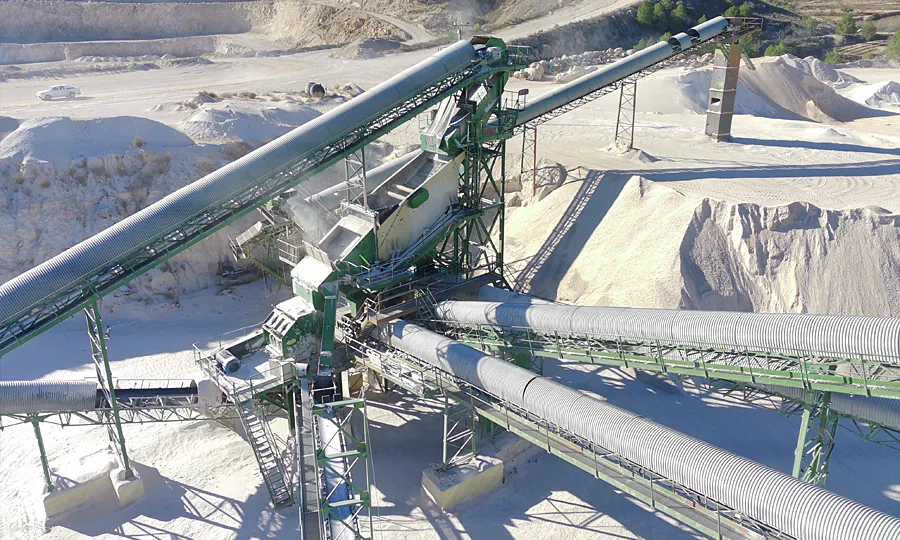
Conveyor belts are among the most important pieces of equipment in modern material processing facilities. Whether in quarry operations, aggregate production plants or recycling facilities, efficient material transport is essential for maintaining productivity, reducing operational costs and ensuring a smooth production flow.
While crushers, screens and sorting systems often receive most of the attention, conveyor systems are the equipment responsible for connecting every stage of the production process. A poorly designed conveying system can quickly become a bottleneck, limiting the performance of the entire plant.
In this article, we explore the role of conveyor belts in aggregate and recycling operations, their benefits and the factors that should be considered when selecting the right solution.
Why Conveyor Belts Are Essential in Material Processing Plants
Every processing plant depends on the continuous movement of materials between different stages of production.
In aggregate facilities, materials must be transported between crushers, screens, stockpiles and storage areas. In recycling plants, conveyor systems are used to move waste streams through screening, sorting and recovery processes.
Modern Conveyor Belts allow operators to automate material handling, reduce manual intervention and improve overall plant efficiency.
Their ability to transport large volumes of material continuously makes them one of the most cost-effective solutions available for industrial operations.
Applications in Aggregate Production
In quarry and aggregate processing plants, conveyor belts perform several critical functions.
Typical applications include:
- Feeding crushers and screening equipment.
- Transporting processed aggregates between production stages.
- Feeding storage silos and stockpiles.
- Loading trucks and transport systems.
- Connecting complete crushing and screening circuits.
When integrated into a well-designed Quarry Machinery installation, conveyor systems help maximise throughput while reducing operating costs.
By maintaining a consistent material flow, they also improve the performance of downstream equipment such as Impact Crushers and Vibrating Screens.
Applications in Recycling Plants
Material transport is equally important in recycling facilities.
Waste recovery operations typically involve multiple stages of screening, separation and classification. Conveyor systems allow materials to move efficiently between each stage while maintaining continuous production.
Common applications include:
- Construction and demolition waste recycling.
- Material recovery facilities.
- Metal separation systems.
- Sorting cabins.
- Waste processing plants.
In modern Recycling Equipment installations, conveyor belts play a fundamental role in maintaining productivity and ensuring efficient material recovery.
Benefits of Conveyor Belt Systems
Increased Operational Efficiency
Conveyor systems eliminate the need for repeated material handling using loaders or other transport equipment.
This reduces production delays and improves overall plant performance.
Lower Operating Costs
Automated material transport requires fewer resources than alternative transport methods.
Reduced fuel consumption, lower labour requirements and improved productivity all contribute to lower operating costs.
Improved Workplace Safety
By reducing vehicle movements and manual material handling, conveyor belts help create safer working environments.
This is particularly important in quarry operations where heavy machinery is constantly moving throughout the site.
Scalability and Flexibility
Modern conveyor systems can be adapted to different layouts, production capacities and operational requirements.
As plants expand, conveyor systems can often be modified or extended to support future growth.
Key Factors When Selecting a Conveyor Belt
Not all conveyor systems are designed for the same application.
Selecting the correct solution requires consideration of several factors.
Material Characteristics
The properties of the material being transported influence the design of the conveyor system.
Important considerations include:
- Material size.
- Abrasiveness.
- Moisture content.
- Bulk density.
- Flow characteristics.
Plant Layout
Conveyor length, inclination and transfer points must be carefully evaluated to ensure efficient operation.
A properly engineered system helps minimise material losses and reduce maintenance requirements.
Production Capacity
The conveyor must be capable of handling the required throughput without creating restrictions within the production process.
Matching conveyor capacity to plant requirements is essential for long-term performance.
Sustainability Benefits
Conveyor systems also contribute to more sustainable industrial operations.
Compared with transport methods that rely heavily on mobile equipment, conveyor belts can significantly reduce fuel consumption and emissions.
Modern systems incorporate energy-efficient motors, automated controls and monitoring technologies that help optimise energy use and reduce environmental impact.
These advantages make conveyor systems increasingly attractive for companies seeking to improve both operational efficiency and sustainability performance.
Integration with Complete Processing Plants
The greatest benefits are achieved when conveyor systems are integrated into a complete processing solution.
Whether in aggregate production or waste recovery operations, conveyor belts must work in harmony with crushers, screens, feeders and separation equipment.
For this reason, many operators choose complete engineered solutions that ensure every component of the plant works together efficiently.
A properly designed system not only improves productivity but also simplifies maintenance and future plant expansion.
Conclusion
Conveyor belts are much more than simple transport equipment. They are critical components that directly influence productivity, operational efficiency and plant profitability.
From aggregate production to waste recovery facilities, conveyor systems help optimise material flow, reduce operating costs and improve safety.
Selecting the right conveyor solution is therefore an important decision that can have a significant impact on the long-term performance of any processing plant.
Looking for a conveyor system for your operation?
JLM Ingeniería designs and manufactures industrial Conveyor Belts for aggregate production plants, recycling facilities and custom material handling applications.